guest@sealogical:~
Frequently Asked Questions

Questions, answered.

11 questions about Sealogical — what it does, how it handles MLC and ISM compliance, what it costs, how data is protected, and how to get started.

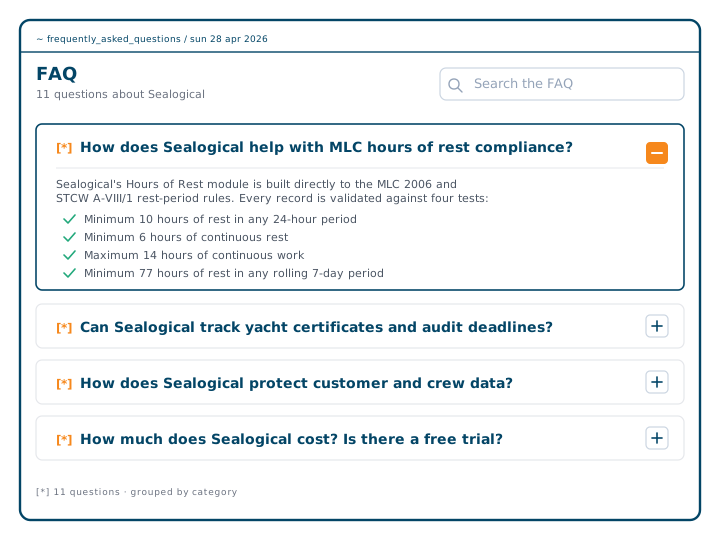
Sealogical FAQ panel mock-up: a stylised CLI-styled help interface showing four expandable question rows; the first one open, displaying an answer about MLC hours of rest with bulleted compliance criteria

Question 01 of 11

What is yacht management software?

Yacht management software is a centralised platform that captains, management companies, and owners use to run a yacht's operational and regulatory workload from one place — replacing spreadsheets, paper logs, and disconnected apps.

Typical capabilities include crew HR management, vessel movements, crew records, certificates and document tracking, planned maintenance, safety management (SMS) under the ISM Code, drills and checklists, charter operations, and fleet-wide reporting.

Sealogical is a yacht management platform built specifically for superyachts and their management companies.


Question 02 of 11

How does Sealogical help with ISM compliance?

The ISM Code requires many yachts to operate a documented Safety Management System (SMS) covering procedures, drills, defect reporting, audits, and continuous improvement.

Sealogical supports ISM compliance by digitising the SMS: storing controlled forms and policies, scheduling and recording safety drills, tracking non-conformities and corrective actions, logging defects, managing certificate validity (DOC, SMC, ISSC), and producing audit-ready reports for flag and class.

Sealogical provides a full ISM-aligned safety module covering forms, drills, defects, permits to work, and audit-ready records.


Question 03 of 11

What features does Sealogical offer?

Sealogical features include but are not limited to:

  • Safety Management System (SMS) for ISM compliance — forms, drills, defects, non-conformities
  • Hours of Rest tracking aligned with MLC 2006 and STCW A-VIII/1
  • Certificates for both vessel and crew, with expiry alerts
  • Crew management including qualifications, scheduling, and multi-vessel transfers
  • Planned maintenance for equipment, tasks, and inventory
  • Permits to Work (hot work, confined space, working aloft, etc.)
  • Vessel movements and logbook for departures, noon reports, and arrivals
  • Charter management for charter yachts, with APA in the Finance add-on
  • Fleet tracking with voyage fuel and CO₂ estimates
  • Multi-vessel, multi-tenant access control with role-based permissions
  • AI document scanning for passports, crew certificates, vessel certificates and supplier invoices
  • Sealogical Intel: search across every module from one box (Cmd/Ctrl+K)

Question 04 of 11

How does Sealogical help with MLC 2006 hours of rest compliance?

Sealogical's Hours of Rest module is built directly to the MLC 2006 and STCW A-VIII/1 rest-period rules. Crew log rest intervals on any device, and Sealogical automatically validates each record against all five statutory tests:

  • minimum 10 hours of rest in any 24-hour period
  • minimum 6 hours of continuous rest
  • rest split into no more than two periods
  • maximum 14 hours between rest periods
  • minimum 77 hours of rest in any rolling 7-day period

Violations are flagged the moment they occur. At month-end, crew submit their sheet, an approver reviews and signs it off with a digital signature, and Sealogical generates an IMO-format report — a 24-column hourly grid with compliance badges and monthly summary — ready for flag-state inspection or audit.


Question 05 of 11

Can Sealogical track yacht certificates and audit deadlines?

Yes. Sealogical tracks both vessel certificates (e.g. SMC, ISSC, MLC, class, statutory) in the Certificates module and crew qualifications (e.g. STCW, medical, GMDSS) on each crew member's record, both with expiry tracking and alerts.

Every certificate has an expiry date, and a scheduled job emails the responsible crew and shore staff in advance of expiry so renewals and audits don't slip. Records are searchable, exportable, and retained for audit history.


Question 06 of 11

Does Sealogical support charter operations and APA management?

Yes. The Charter module covers charter records from option to completion, a charter planner, guest lists with the IMO FAL Form 6 export, and charter documents. APA (Advance Provisioning Allowance) management is part of the Finance add-on: APA deposits, expenses, fuel records and adjustments are tracked per charter, with settlement statements at the end.

Guest records are kept securely separate from crew records and tied to specific charters.


Question 07 of 11

How does Sealogical handle crew management across a fleet?

Sealogical is multi-vessel by design. A management company can run one fleet or many, with crew profiles, qualifications, scheduling, and section-level permissions managed centrally.

Crew can be transferred between vessels in the same fleet without re-entering their records, and access is controlled at the section level (crew, safety, certificates, technical, charter, finance) so each user sees only what their role requires.

Fleet-wide reporting rolls up every vessel into one view for managers.


Question 08 of 11

How does Sealogical protect customer and crew data?

Section-level permissions.

  • Within a vessel, access is granted per section (crew, safety, certificates, technical, vessel, charter, finance) so each user sees only what their role requires. Sensitive data (e.g. crew personal records, finance, charter guest information) is gated separately from operational data.

Two-step sign-in.

  • Every sign-in asks for a one-time code emailed to the user, on top of the password, unless that browser was trusted in the last 30 days. Repeated failed attempts lock the account for 15 minutes.

Encryption in transit and at rest.

  • All traffic is served over HTTPS, and data is encrypted at rest in the underlying Postgres database (Supabase / AWS).

Hosted on enterprise infrastructure.

  • Sealogical runs on Supabase (Postgres) and Vercel, both of which are SOC 2 Type II certified at the infrastructure level.

Audit trail.

  • Sensitive actions (sign-offs, approvals, permission changes) are logged with the user and timestamp.

Question 09 of 11

How much does Sealogical cost? Is there a free trial?

Sealogical is priced at €320 / £280 / $360 per vessel per month, which includes every module except the optional Finance and Deck Plans add-ons.

The Finance module is an optional add-on at €320 / £280 / $360 per vessel per month. It includes Accounting (a general ledger with bank reconciliation and financial reports) and crew payroll.

Deck Plans is an optional add-on at €80 / £70 / $90 per vessel per month, with a 30-day free trial on each vessel.

Sealogical offers an unlimited free trial with no credit card required.


Question 10 of 11

Who uses Sealogical, and how long has it been around?

Sealogical began life in 2003 supporting a fleet of 7 yachts, and has gone on to support over 1,000 vessels worldwide over the years, ranging from privately operated superyachts to large management-company fleets.

Customers include captains, senior crew, and shoreside management teams who use Sealogical as the system of record for safety, crew, certificates, maintenance, and charter operations.


Question 11 of 11

How do I get started with Sealogical?

The fastest way to get started is to book a demo at sealogical.com/contact. A member of the team will walk you through the modules relevant to your operation (private vs. charter, single yacht vs. fleet), set up a trial environment with your vessel data, and help your captain and crew onboard.


Still have questions?

Book a demo and we'll walk you through the modules relevant to your operation, set up a trial environment, and help your captain and crew onboard.